
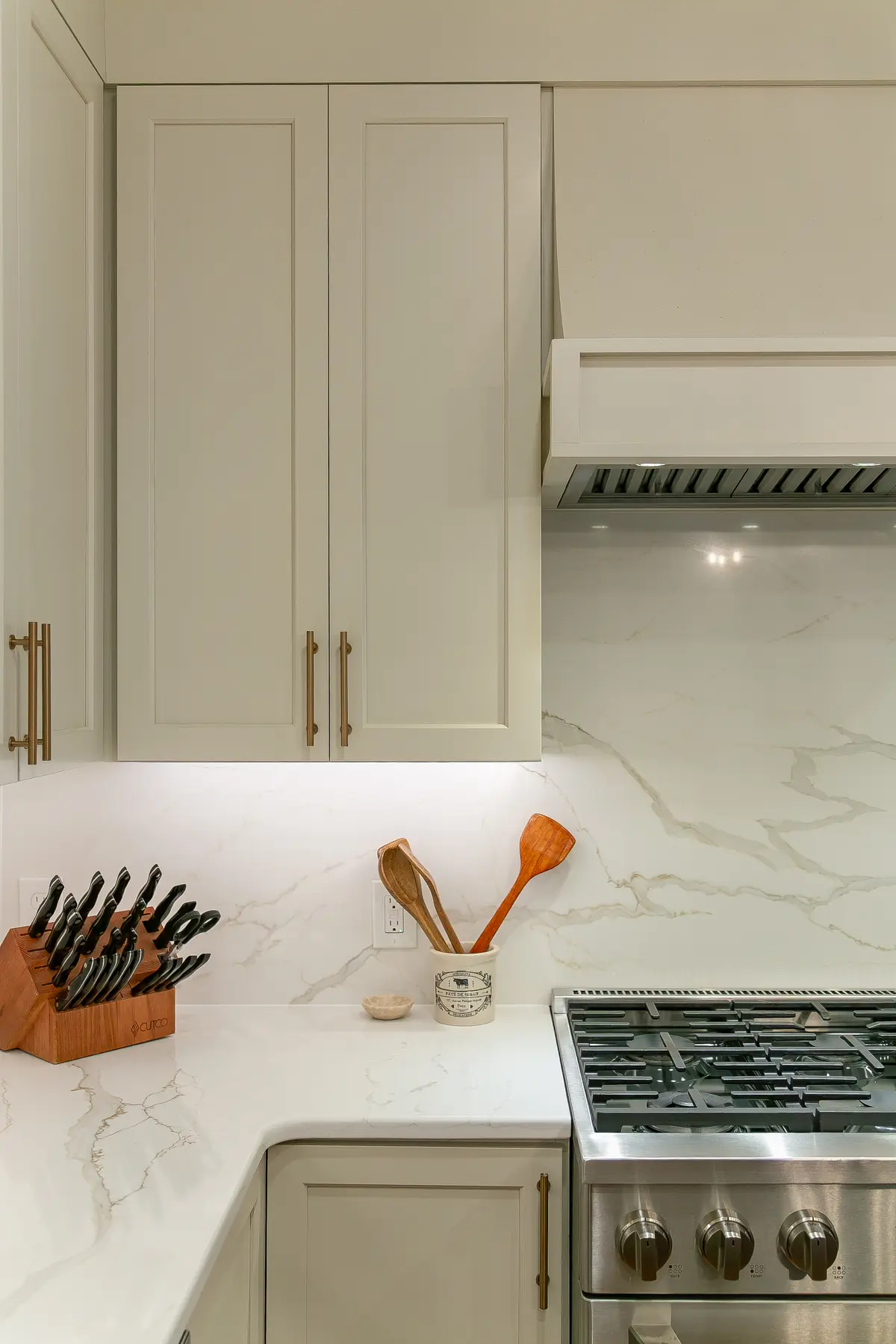
There is a moment after dinner when the kitchen finally settles down. Plates are cleared, the counters are wiped, and the lights soften. The wall behind the range is still there in plain view—either bringing the room together or competing with everything around it. Choosing a backsplash is partly about that feeling, and partly about how easily the kitchen handles the splashes and cleanup that come before it.
Choose tile if you want control over pattern, scale, and color. Consider a full-height slab if you prefer a more continuous surface and fewer grout joints. Neither is automatically more practical, more timeless, or better made. The right choice depends on the exact material, the room, the installation details, and the care you are comfortable giving it.
For homeowners planning a kitchen remodel in Williamsburg and the surrounding area, this is a decision worth making alongside the cabinetry, countertops, appliances, and lighting—not as the final item on a shopping list.
First, Separate the Material From the Look
Tile describes a format, not one material. A glazed ceramic tile, porcelain tile, natural-stone mosaic, and textured handmade tile can behave quite differently. A slab backsplash can also be natural stone, engineered quartz, porcelain, or another approved surfacing product. A marble appearance does not tell you what the product actually is.
Ask for the product name, finish, intended use, and written care instructions before comparing options. A sample that photographs beautifully may have a texture that catches cooking residue or a finish that needs more care than you expected. The question is not simply “tile or slab?” It is “which tile or which slab, installed in what way?”
When Tile Makes Sense
Tile offers many ways to give a kitchen personality without asking every surface to be a focal point. A simple rectangle can feel quiet with a coordinating grout color. A contrasting grout or herringbone layout makes the pattern more noticeable. Small mosaics introduce many joints; larger tiles create fewer divisions. Those choices affect both the look and the cleaning routine.
Tile may be a good fit when you want:
- A particular color, glaze, texture, or repeating pattern.
- A backsplash that complements, rather than repeats, the countertop.
- Flexibility around windows, short wall sections, or an unusual layout.
- The possibility of replacing individual damaged pieces, provided matching spare tile is available and the installation allows it.
The trade-off is that grout and surface texture become part of the maintenance plan. Ask which grout is specified, what cleaning it needs, and whether sealing is recommended for that particular tile-and-grout combination. Do not assume every grout or tile has the same requirements.
Our completed Ford’s Colony kitchen shows another direction: a blue herringbone tile backsplash paired with white cabinetry and brass details. It is a useful visual contrast to the slab surface featured here, not a prescription that one style belongs in every home.
When a Full-Height Slab Makes Sense
A full-height backsplash continues from the countertop to the underside of the cabinets or another deliberately chosen stopping point. Using a slab can let veining or a broad field of color carry across the wall without the repeated grid of tile joints. It can feel especially composed when cabinetry, hardware, and lighting already provide plenty of detail.
The photograph above comes from VanFleet Homes’ Kingsmill blue-island kitchen remodel. It shows a softly veined, marble-look slab backsplash behind the range and beneath warm white cabinetry. We describe the visible finish as marble-look rather than assume a material specification from the photograph. You can see how that wall relates to the island and the rest of the room in the full project gallery.
A slab may suit you if fewer grout joints and a quieter visual field matter most. But fewer joints does not mean no seams, no sealant, or no maintenance. Panel size, corners, cutouts, access into the house, and fabrication limits all influence the finished result. Ask to see the proposed seam and edge locations before approving the layout.
Compare the Cleaning You Will Actually Do
Picture your normal week. Does the range see frequent frying? Is the coffee station used throughout the day? Will you happily wipe a textured surface, or do you want the simplest possible cleanup? Test samples in person where practical, and read the care guidance rather than relying on “low-maintenance” as a blanket promise.
Natural stone needs care suited to the stone. The Natural Stone Institute’s care guidance explains that acidic products can etch certain stones and that sealing improves stain resistance rather than making stone stain-proof. Ask your supplier what applies to your selection. Engineered surfaces and tile also need their own manufacturer-approved cleaning methods.
Pay attention to the joints where the backsplash meets the counter, corners, and adjoining materials. The installation team should specify the appropriate joint treatment; those transitions need care regardless of whether the main surface is tile or slab.
Resolve Outlets, Edges, and Heat Before Ordering
The small details often decide whether a backsplash feels carefully finished. Before materials are ordered, work through these questions with the design and construction team:
- Where will it stop? Identify the finish at cabinet ends, windows, hood surrounds, and open wall sections. Avoid an unplanned strip that ends awkwardly in the middle of a wall.
- Where will outlets and switches land? Coordinate required electrical devices with the tile layout or slab cutouts. A cleaner appearance must not come at the expense of applicable electrical requirements.
- What happens behind the range? Confirm that the selected surface and installation assembly are suitable for the appliance, including the manufacturer’s clearances and heat requirements. A display photograph is not installation approval.
- How will the wall be prepared? Existing walls may need correction before a new finish can sit properly. Substrate preparation, support, and attachment should follow the selected system’s requirements.
- How will the lighting affect it? View samples under the planned task lighting. Strong light can emphasize texture, reflections, or surface irregularities that were less noticeable in a showroom.
These are good reasons to choose the backsplash while the kitchen is being designed. VanFleet’s Design-Construct process connects selections with the work needed to install them thoughtfully. Craftsmanship is not only the final surface; it is also the planning that allows those edges, joints, and adjoining elements to meet well.
Compare Installed Scope, Not Just Material Prices
A tile price per square foot and a slab price do not describe equivalent scopes. A useful comparison includes wall preparation, material quantities and waste, pattern layout or slab fabrication, edge finishing, outlets and other cutouts, delivery and handling, installation, joint treatment, and any related electrical work.
A modest tile in an intricate pattern can require substantial installation time. A slab may need additional material because of the wall dimensions or the placement of veining. Keeping countertops may also create different constraints from replacing countertops and backsplash together. Ask what is included and excluded rather than assuming one approach must cost less.
If the overall investment is still taking shape, our guide to where to invest most in a kitchen remodel can help put this choice in perspective. The backsplash should support a kitchen that functions well, not consume the budget needed to correct its everyday frustrations.
Bring the Whole Room Into the Decision
Set the cabinet finish, countertop sample, backsplash, hardware, and flooring together. Look at them in daylight and evening light. Decide which element should lead and which should stay quiet. A dramatic countertop does not require a dramatic backsplash; a calm countertop can leave room for expressive tile.
For a home in Kingsmill, the surrounding rooms may be just as important as the kitchen itself. Consider what you see from the dining or living area and whether the new materials feel connected to the character you already love. The same question is useful throughout Williamsburg, James City County, and York County: will this room feel like part of our home, or like a display placed inside it?
A Kitchen That Feels Like Yours
The best backsplash is not the one with the most impressive label. It is the one you enjoy looking at, understand how to care for, and feel comfortable living with. That might be a simple tile wall, a richly colored pattern, or a continuous slab with gentle movement.
At VanFleet Homes, our mission is creating home. That means listening to the small everyday preferences as closely as the big design ideas. Meet our team, browse homeowner reviews, or tell us what you are hoping your kitchen will feel like. We can begin with a conversation about what matters to you, then bring design and construction together around it.